How Generative AI is Reshaping Investment Strategies
The AI Revolution in Financial Markets
The investment landscape is undergoing a profound transformation as generative AI technologies redefine traditional approaches to market analysis, risk assessment, and portfolio management. With private investment in generative AI reaching $33.9 billion in 2024 – an 18.7% increase from 2023 and over 8.5 times higher than 2022 levels (Stanford AI Index Report, 2025) – the financial sector stands at the forefront of this technological revolution.
As we navigate through 2025, the integration of AI into investment strategies has moved beyond theoretical applications to become a practical necessity for firms seeking competitive advantage in increasingly complex markets.
The Current State of AI in Investment Management
Despite the buzz surrounding AI in finance, adoption of formal AI-driven investment strategies remains surprisingly selective. According to a 2025 European Securities and Markets Authority report, only 145 out of 44,000 UCITS funds in the European Union explicitly incorporate AI or machine learning in their formal investment strategies. However, this statistic masks the widespread behind-the-scenes implementation of AI tools, particularly large language models (LLMs), which are increasingly supporting research, productivity, and decision-making processes.
The financial services industry's commitment to AI is substantial and growing. In 2023, financial services firms invested $35 billion in AI technologies, with projections indicating this figure will reach $97 billion by 2027 across banking, insurance, capital markets, and payment businesses. This makes financial services one of the most heavily AI-invested industries globally.
Enhanced Market Analysis and Pattern Recognition
Generative AI is revolutionizing how investment professionals analyze market data. Unlike traditional analytical tools, generative AI can process vast amounts of unstructured data – including news articles, social media sentiment, earnings call transcripts, and macroeconomic indicators – to identify patterns and correlations that human analysts might miss.
According to Goldman Sachs recent Asset Management Insight, AI is “creating opportunities for up-skilling and more human-generated value creation”. This human-AI collaboration represents the optimal approach to investment analysis, combining the creative thinking of experienced professionals with AI's computational power.
Risk Management and Scenario Simulation
One of the most powerful applications of generative AI in investment management is the simulation of market microstructure during stress periods. Using generative techniques, systems can create realistic order book dynamics that reflect how liquidity might evolve during market disruptions. This allows firms to stress-test their trading algorithms and risk management systems against a broader range of scenarios than historical data alone would permit.
McKinsey research highlights that AI quantitative trading systems consistently outperform conventional methods, enabling developers to build applications 56% faster. This acceleration is reflected in patent filings, with AI-related algorithmic trading innovations showing a steep rise from 19% in 2017 to more than 50% since 2020.
Personalized Portfolio Management
Generative AI is enabling unprecedented levels of portfolio personalization. The technology can analyze individual investor preferences, risk tolerance, financial goals, and market conditions to create highly customized investment strategies.
A recent insight from MDOTM highlights how separately managed accounts (SMAs) are being transformed by AI's ability to tailor investment approaches to individual client needs while maintaining institutional-grade portfolio management practices.
The Algorithmic Trading Revolution
The integration of AI into algorithmic trading represents perhaps the most direct application of this technology in investment management. Patent applications for algorithmic trading showed AI content jumped from 19% in 2017 to over 50% by 2020, coinciding with the emergence of Large Language Models (LLMs).
By 2025, AI-driven trading algorithms have evolved to offer real-time portfolio optimization, automated risk assessment, and data-driven strategies that minimize human biases. These systems empower both retail and institutional traders to make more informed decisions by rapidly analyzing vast data sets and uncovering patterns undetectable by human analysts.
Global Investment Landscape and Regional Disparities
The United States continues to dominate global AI investment, with private AI investment reaching $109.1 billion in 2024 – nearly 12 times higher than China's $9.3 billion and 24 times the UK's $4.5 billion. This disparity is even more pronounced in generative AI, where U.S. investment exceeded the combined total of China and the European Union plus UK by $25.4 billion.
Meanwhile, Asia Pacific markets have experienced a decline in investment activity due to smaller amounts of investment dry powder and tensions between China and the U.S. However, some analysts predict a potential reversal of this trend, with institutional investment in large-scale AI and generative AI implementations in the region projected to reach $110 billion in the near future.
Challenges and Considerations
Despite its transformative potential, generative AI in investment management faces several challenges:
- Explainability and Trust: Investment decisions based on complex AI models may lack transparency, raising concerns about regulatory compliance and client trust.
- Data Quality and Biases: AI systems are only as good as the data they're trained on, and biases in historical financial data can lead to skewed investment recommendations.
- Overreliance Risk: As noted by MIT’s "Brains on Autopilot" study, excessive dependence on AI tools can potentially diminish critical thinking skills among investment professionals.
- Regulatory Uncertainty: The rapidly evolving regulatory landscape for AI in financial services creates compliance challenges for firms implementing these technologies.
The Future of Financial Decision AI
Looking ahead, the generative AI market is expected to reach around USD 1 trillion by 2034, according to Precedence Research. This growth will continue to transform investment strategies in several key ways:
- Augmentation Over Replacement: AI's primary value in investment management lies in augmenting human capabilities rather than replacing them. The most successful firms will be those that effectively combine human expertise with AI-powered insights.
- Democratization of Sophisticated Strategies: AI tools are making advanced investment strategies accessible to a broader range of investors, potentially reducing the information asymmetry that has historically benefited institutional players.

- Enhanced Client Communication: Generative AI is streamlining client service and reporting by helping advisors draft client reports, summarize portfolio performance, and create explanatory materials tailored to a client's interests and investment style.
Conclusion
As we progress through 2025, generative AI is not merely an optional enhancement to investment strategies – it's becoming a fundamental component of competitive financial decision-making. The technology's ability to process vast amounts of data, identify non-obvious patterns, simulate complex scenarios, and personalize investment approaches is transforming how capital is allocated across global markets.
For investment professionals, the key to success lies not in resisting this technological shift but in developing the skills to effectively collaborate with AI systems, leveraging their computational power while applying human judgment, creativity, and ethical considerations to the investment process. Those who master this human-AI partnership will be best positioned to navigate the increasingly complex financial landscape of the coming decade.
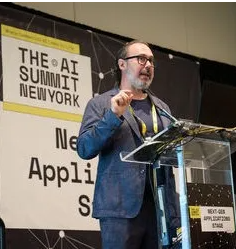

Learn more about how AI can impact your organization's investment strategies at The AI Summit New York, this December 10-11.
To stay on top of the latest news in AI for business, subscribe to The AI Summit Series newsletter, Beyond The Summit.
)